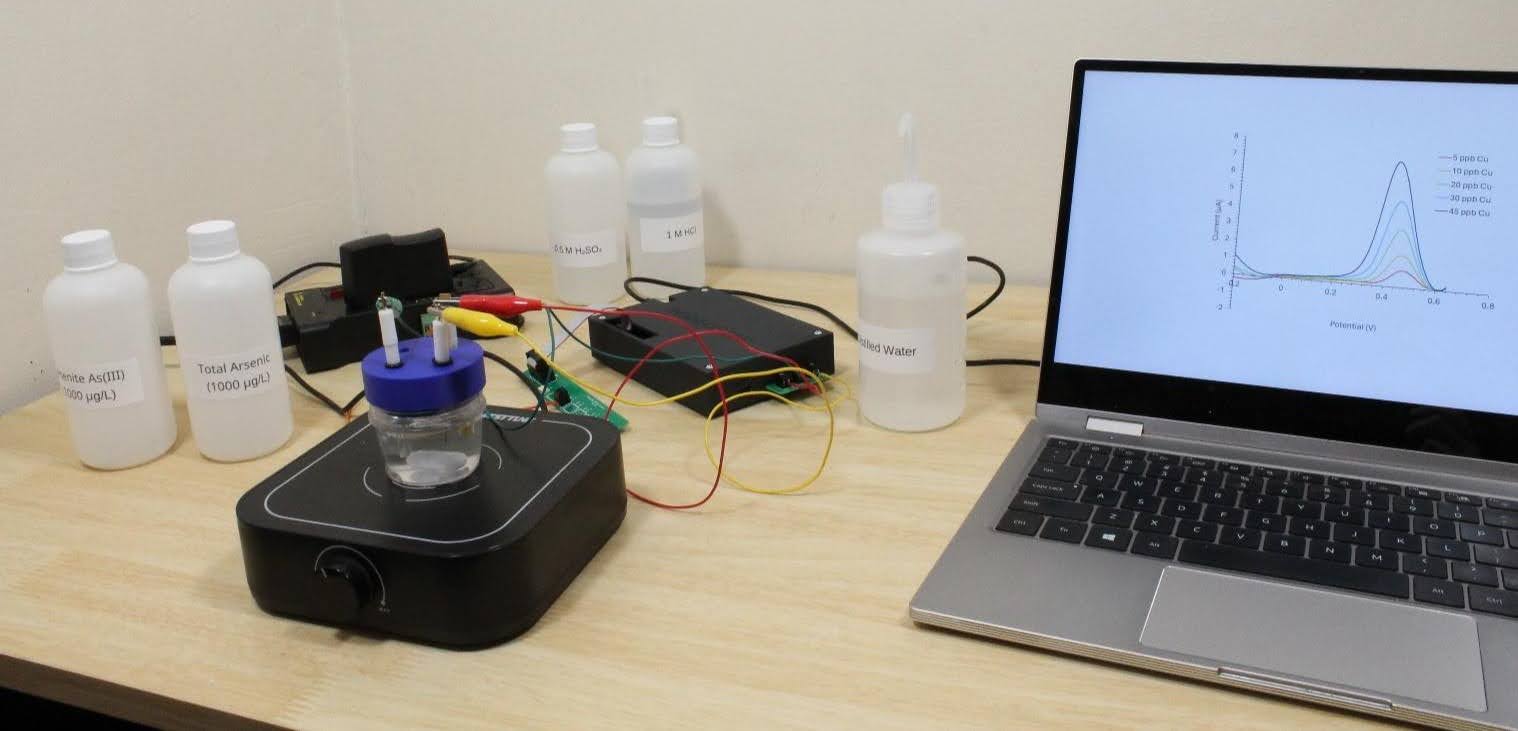
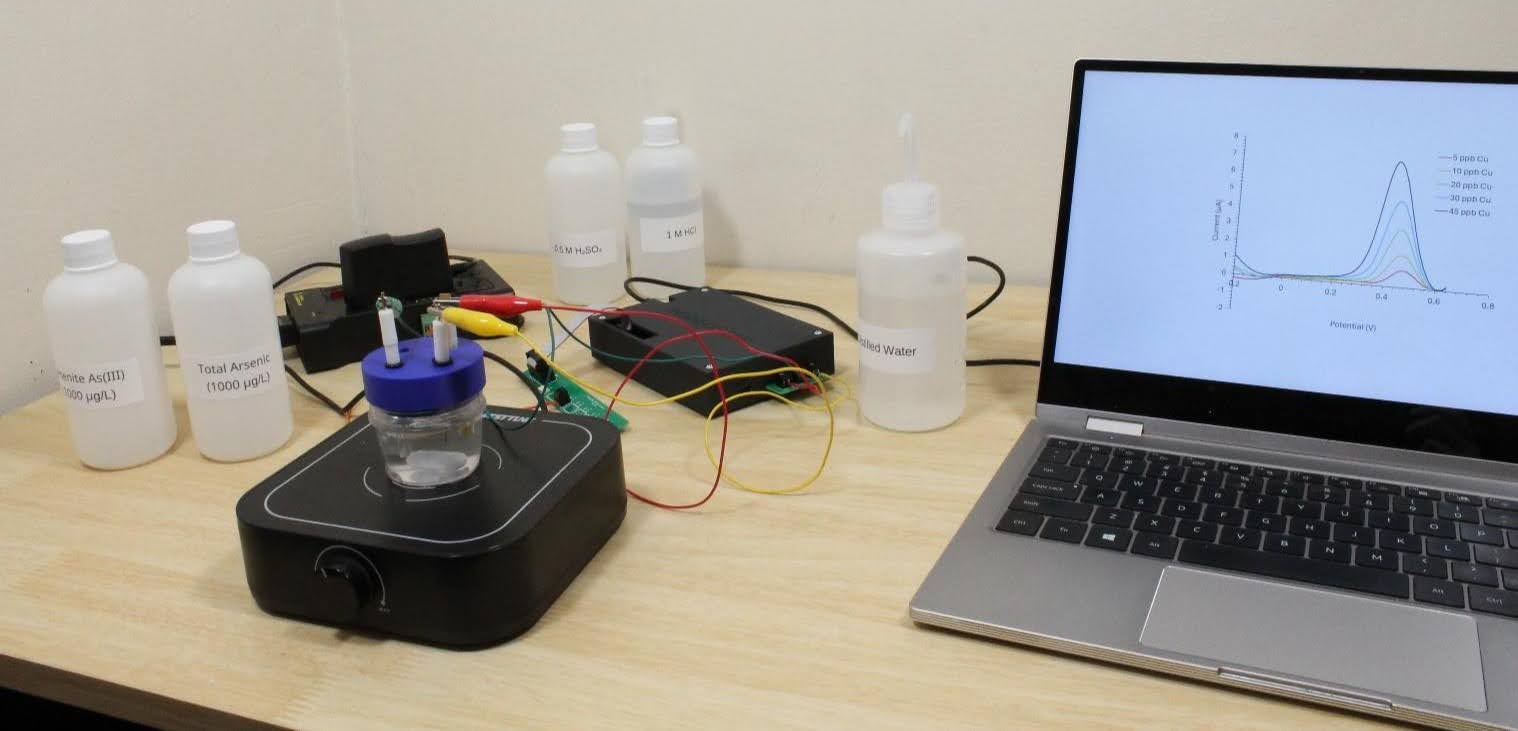
Introduction
Brief introduction to the arsenic concentration test measurement process.
Background – Electro-plating,-stripping
Chemically, a salt is a compound composed of a positively charged ion, typically a metal, and a negatively charged ion bound together so as to be electrically neutral.
When a metallic salt is dissolved in water, the molecules separate into positively charged metal ions called cations and negatively charged ions called anions. A familiar example of this is table salt: The salt (sodium chloride) separates into positively charged sodium (called “cations”) and negatively charged chloride (called “anions”). If two electrodes are lowered into the solution containing a dissolved salt and an electric voltage is applied between them, ions will move; the positive ions towards the negative electrode and the negative ions towards the positive electrode. The cations are reduced (neutralized) at the negative electrode by electrons flowing from the battery, and they coat (“plate” or “electroplate”) the negative electrode. If the battery polarity is reversed after metal has been plated onto an electrode, the process reverses and the plated metal returns to the solution (is oxidized or “stripped”) and become cations again.
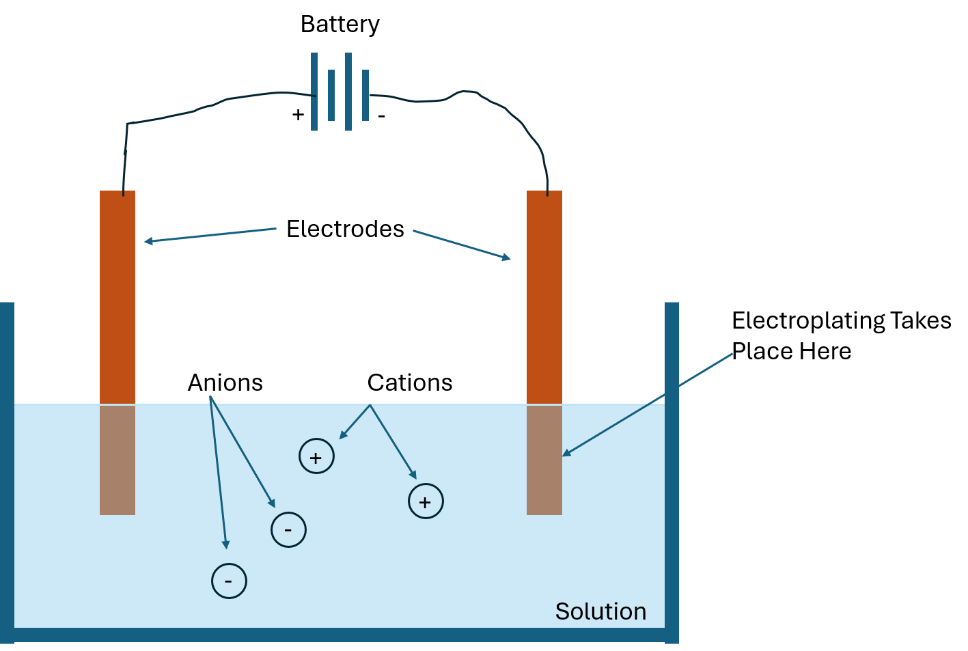
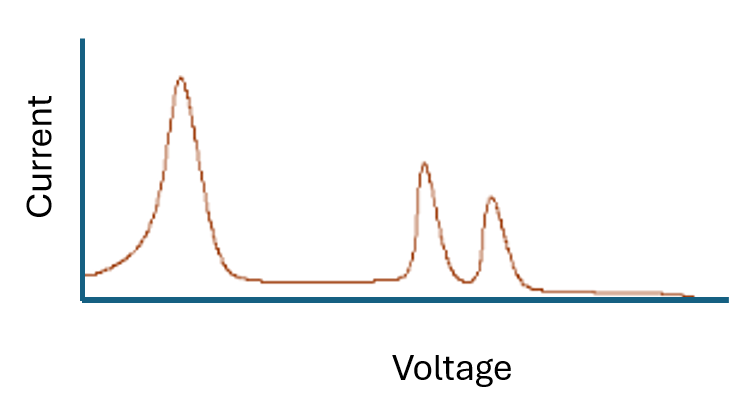
The amount of current flowing during stripping depends on the amount of ions that have been plated onto the electrode, and peaks at the voltage at which the metal begins to be oxidized. If the voltage is increased linearly (swept) over time, the current will show a peak for each metal being oxidized.
Background – Potentiostat
In order to study the curve(s) shown above, we need to apply a controlled voltage across the electrodes in our solution and measure the current flowing. In principle, the simple electroplating setup with two electrodes shown above should be all we need.
In practice, however, a problem arises: At the electrode-liquid interface, very many unspecified “things” can happen, depending on what chemicals are in the solution. In many cases a “resistance” layer arises. An electrical resistor is a material that creates a voltage across it when a current flows through it. In this situation we have an unknown and dynamic (changing) value of resistance, so we have an unknown, changing, voltage in our current path. The bottom line here is that we cannot determine the current–voltage curve we want from a simple two-electrode system. Enter: the potentiostat!
A potentiostat is a device which cleverly sidesteps the above problem and allows us to learn the current–voltage relationship we want. The potentiostat measurement requires three electrodes in the solution:
- The Working electrode: This is the electrode where metal (arsenic in our case) will be plated.
- The Counter Electrode: This is the electrode that completes the circuit and enables the current flow at the Working electrode.
- The Reference Electrode: The potentiostat adjusts the voltage until there is zero current flowing through this electrode (except for a miniscule current required for the voltage measurement itself). In this way the effect of an unknown resistance at the working electrode does not affect the measurement.
In summary, a potentiostat controls the voltage between the working and the reference electrodes by adjusting the current flowing through the counter electrode. Modern potentiostats, using a combination of analog and digital circuitry, set the desired voltage (under computer control) so as to establish and maintain the zero-current condition at the reference electrode, and at the same time measure the current flowing at the working electrode.
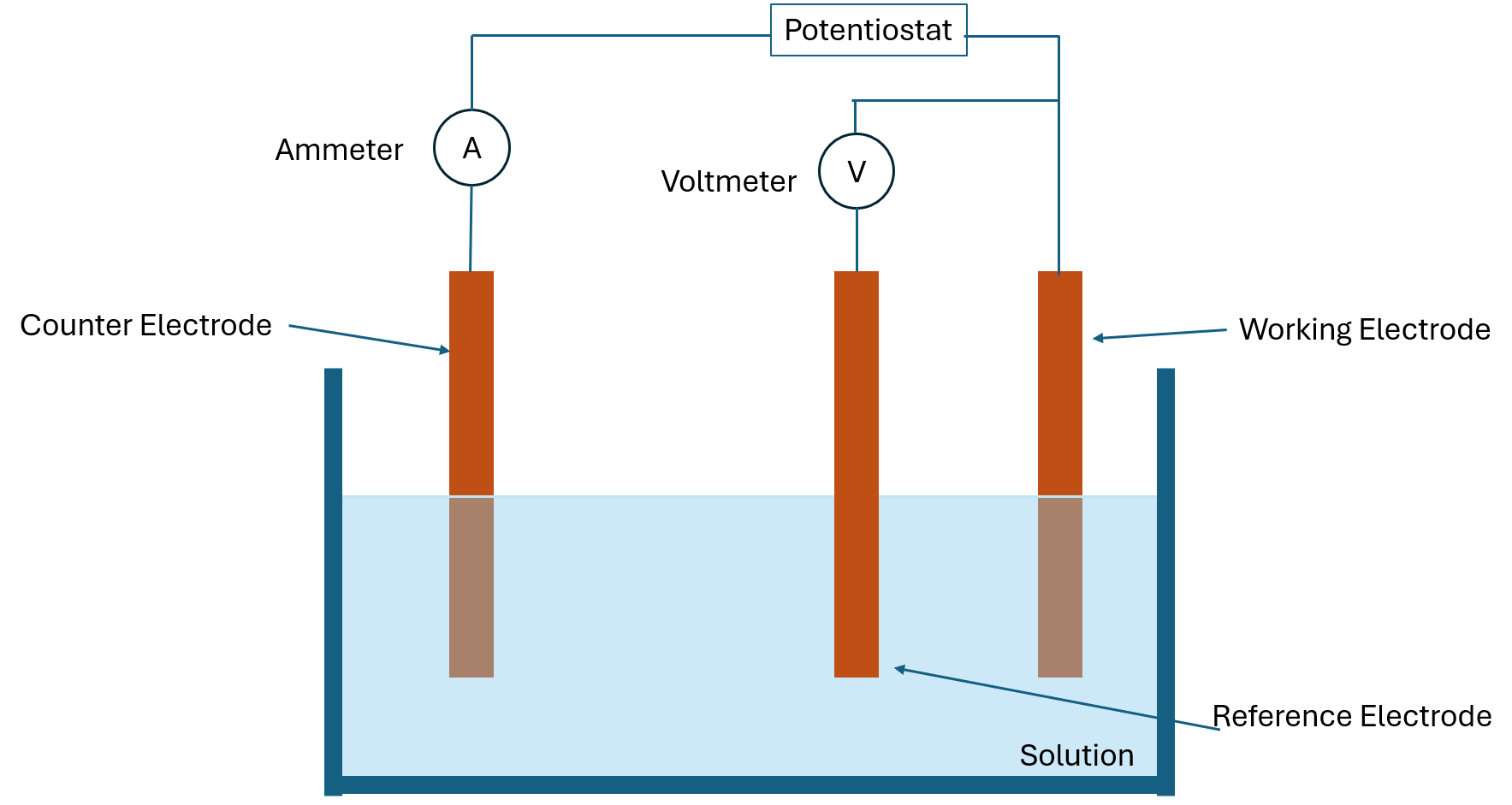
Measuring the Arsenic Concentration in Water
Note: This description is a simplified version of the actual procedure, intended only to present the fundamental logic of the measurement.
Suppose we have (current) data from a voltage sweep (ie. we have plated arsenic onto the working electrode, then have swept the voltage until the arsenic was all stripped (oxidized) from the electrode, generating a peak in the current) and we clearly see the desired arsenic peak. Now what?
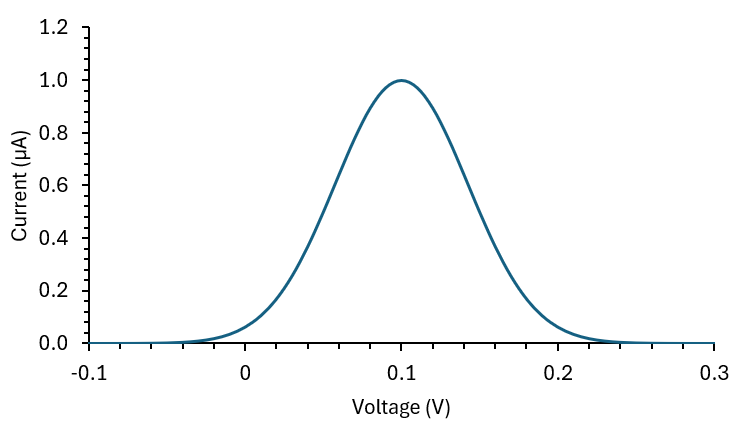
We believe that the height of the peak above the bottom of the curve (the Baseline) is proportional to the arsenic concentration, but we have no scale factor. In other words, we do not yet have enough information to learn the arsenic concentration.
The answer to this problem is known as the Standard Addition method. We have on hand a bottle of concentrated, known specified concentration, arsenic solution. We add a known but very small volume of this concentrate to our test solution so that we are increasing the arsenic concentration by, say, 10 ppb. We then run our test again and record the data. This is the first standard addition. Now we add more concentrate so that we have increased the initial arsenic concentration by 20 ppb. We run our test again. This is the second standard addition..
Plotting all three runs on the same graph, we see these three curves. Let us name the peak values of the test, first standard addition and second standard addition curves as P0, P1 and P2, respectively.
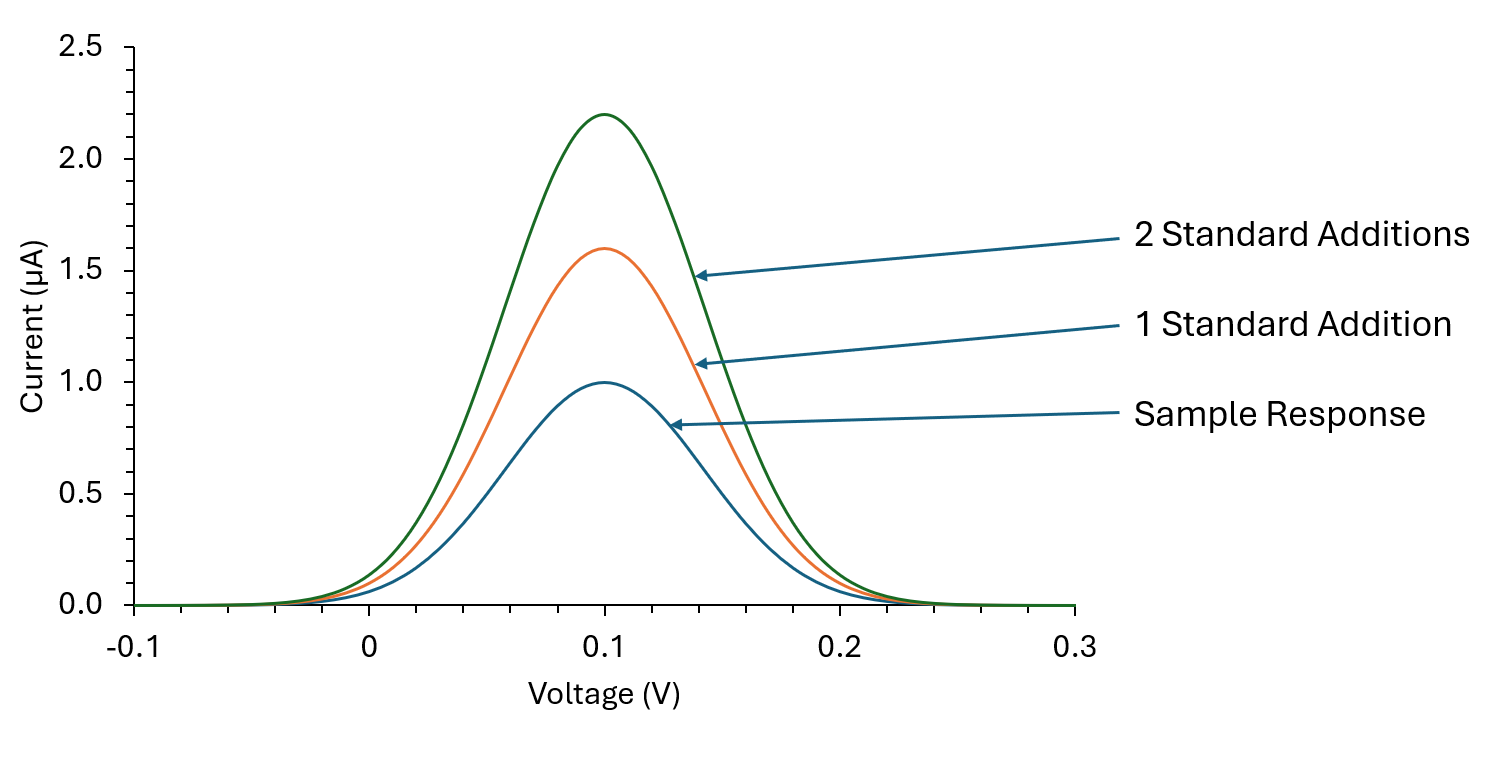
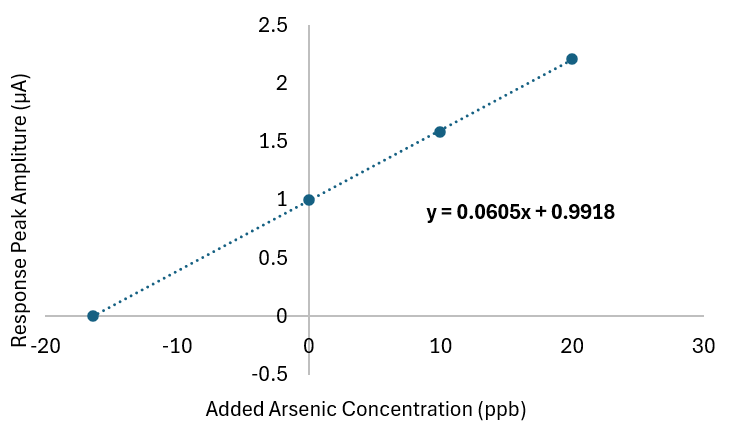
Plot these three points as the Y values of a graph. The corresponding X values are the amount of standard addition related to each point: in this example 0, 10 and 20 ppb, respectively.
The three plotted points form a line. In practice, small errors in measurement often create three points not exactly in line, so we calculate the “best fit” line to the points. A simple mathematical derivation shows that the original arsenic concentration in our solution is simply the negative of the value where this line crosses the y axis – in this example, 16.4 ppb.
How OpenArsenic works
The current OpenArsenic method is intended for the measurement of dissolved arsenic in groundwater using anodic stripping voltammetry (ASV). The method was developed and optimized primarily for:
- Groundwater monitoring
- Drinking water monitoring
- Water treatment evaluation
- Environmental research applications
The system is not intended to replace accredited laboratory techniques such as ICP-MS or ICP-OES in situations where regulatory compliance requires certified analytical results. Instead, OpenArsenic provides a low-cost and accessible alternative for screening, monitoring, research, and operational decision-making. Users should carefully evaluate whether the method is appropriate for their specific application and regulatory requirements.
At the time of writing, the OpenArsenic platform has completed laboratory optimization and initial user testing. The analytical method has been optimized using a gold microwire electrode and a Rodeostat potentiostat, and performance has been evaluated using both laboratory standards and natural groundwater samples.
Current validation work has demonstrated:
- A detection limit of approximately 0.5 µg/L (ppb)
- A linear working range of approximately 0.5–25 µg/L (ppb)
- Strong agreement with ICP-MS measurements across a set of groundwater samples
- Successful operation using the OpenVoltam graphical user interface
In addition to analytical validation, the project is undergoing usability testing to evaluate whether new users can successfully perform arsenic measurements using only the provided software and documentation.