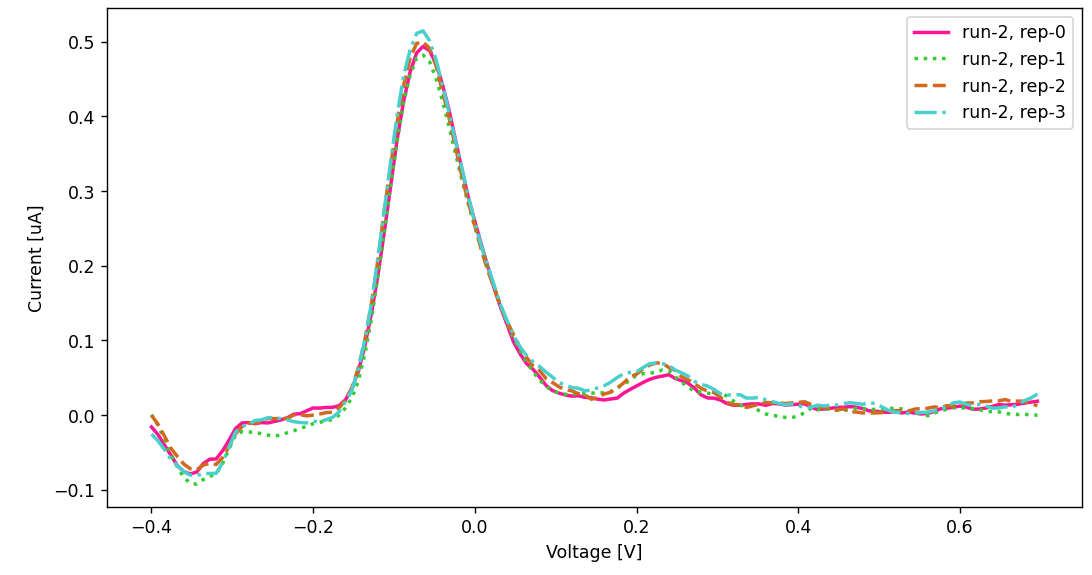
Data analysis criteria for conditioning, measurements and standard addition steps.
15.1 Conditioning acceptance criteria
Status
Observation
Decision
PASS
Conditioning response is similar to previous runs; no abnormal spikes; no saturation of the peak (if peak height is above the current range it will be saturated).
Proceed to arsenic measurement.
QUESTIONABLE
Some drift or irregularity, but no obvious failure.
Repeat conditioning once; proceed only if improved.
FAIL
Large spikes, missing expected features, saturation, or very abnormal response.
Inspect connections and electrode; repeat conditioning or replace electrode.
15.2 Measurement acceptance criteria
Status
Observation
Decision
PASS
Clear single arsenic peak, stable baseline, consistent peak position across repetitions.
Proceed to calculation.
QUESTIONABLE
Peak visible but noisy, baseline difficult, or repetitions show moderate variability.
Review peak analysis and consider repeating run.
FAIL
No clear peak, severe noise, large peak shifts, or inconsistent baseline selection.
Do not use for quantification; troubleshoot and repeat.
BELOW LIMIT OF DETECTION
Background current looks similar to previous runs, stable, no peak visible.
Most likely that sample contains arsenic below the limit of detection (<0.5 ppb). Report this as ‘<LOD’.
15.3 Standard addition acceptance criteria
Check
Good result
Warning sign
Peak growth
Peak height increases after each standard addition.
Peak does not increase or decreases after addition.
Regression
Data appear approximately linear.
Curved response, obvious outlier, or poor fit.
Replicates
Repetitions are reasonably consistent.
One or more repetitions differ strongly from the others.