

Part 16. Troubleshooting
This troubleshooting section includes recommended actions.
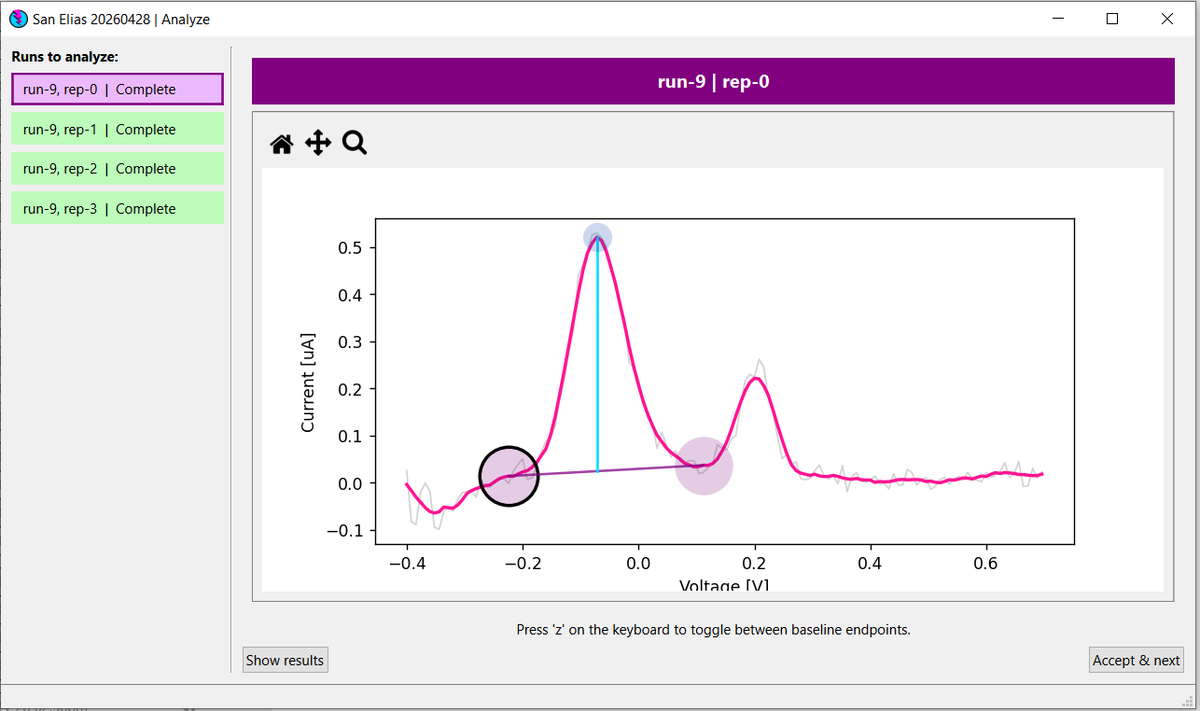
Troubleshooting should always start with the simplest possible causes: cable connection, electrode placement, software/device communication, sample preparation, and electrode condition.
| Problem | Likely cause | Recommended action |
|---|---|---|
| No peak visible | Low arsenic concentration, electrode not active, incorrect connections, wrong method, or failed deposition. |
Check WRK/REF/CTR connections, repeat electrode conditioning, verify method file. • If sample is diluted: use a less diluted sample. • If sample is not diluted: proceed to standard addition (if peak appears then arsenic is below the detection limit for the sample). |
| Very noisy signal | Poor electrical contact, unstable electrode, stirrer issue, USB interruption, or external electrical noise. | Check cables, stop other software, ensure stirrer is off during stripping scan, repeat run. |
| Peak shifts significantly | Electrode condition, reference electrode problem, contamination, or co-occurring chemical species interfering. | Inspect reference electrode, repeat conditioning, run blank/standard control. |
| Signal saturation | Current range too low or arsenic concentration too high. | Dilute sample or verify method current range. |
| Poor standard addition regression | Pipetting error, inconsistent peak analysis, electrode drift, or exceeding linear range. | Review run notes and peak analysis; repeat standard additions if needed. |
| Software error during run | USB interruption, device disconnection, high computer load, or interrupted measurement. | Follow software prompt. Repeat measurement if error occurred during deposition. |
| Error after background scan | Most critical analytical data may already have been collected. | Usually acceptable to save data and continue, but review result carefully. |
| Error during deposition | Analytical signal may be invalid. | Repeat the measurement. |
Table of troubleshooting examples: good peak, noisy signal, missing peak, saturated signal, poor baseline, and poor regression.