Part 9. Conditioning the gold electrode
Objective: clean and re-activate the working electrode surface to ensure stable arsenic measurements.
Objective: clean and re-activate the working electrode surface to ensure stable arsenic measurements. Before accurate arsenic measurements can be made, the electrode surface must be clean, stable, and reproducible.
9.1 When to run electrode conditioning
- Before the first measurement of the day.
- After electrode contamination or drift.
- Whenever results appear unusual, such as distorted peaks or unstable baselines.
- After replacing or manually cleaning the working electrode.
9.2 Setup
- Open OpenVoltam.
- Select Open Sample, or create a new sample if starting fresh.
- Ensure the working, reference, and counter electrodes are properly installed in the conditioning solution.
9.3 Run execution
- Click New Run.
- Select method: Electrode Conditioning. If this method does not appear in the drop-down menu, click “load from file” and select the electrode conditioning method (.ovm) file.
- Select device: Rodeostat.
- Run type: Blank.
- Set repetitions: 1.
- Click Ready to Run.
- Click Begin Run.
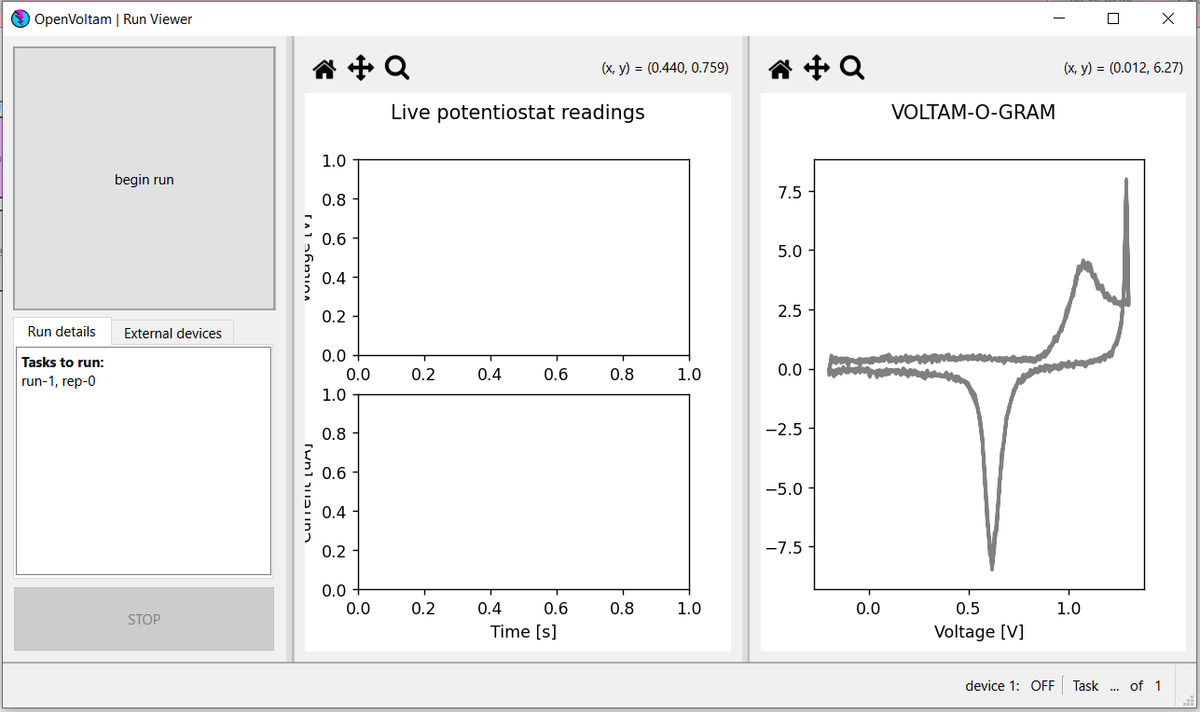
- Observe the live voltammogram. You should see stable, repeatable cleaning behavior.
9.4 During the run
- Do not disconnect the device.
- Avoid USB interruptions.
- Do not run other heavy software.
- Ensure the stirrer behaves as expected if used.
9.5 Completion check
| Conditioning result | Interpretation | Action |
|---|---|---|
| Stable response, no abnormal spikes, no saturation | Electrode is likely ready for arsenic measurements. | Proceed to blank or sample measurement. |
| Large spikes or unstable response | Possible poor connection, contamination, or software/device interruption. | Repeat conditioning once and inspect connections. |
| Response very different from previous conditioning runs | Possible electrode damage or contamination. | Inspect and clean electrode; replace if needed. |
| Flat or abnormal response | Possible incorrect connections or damaged electrode. | Check WRK/REF/CTR connections and electrode placement. |